Domestic is your local competition. Your child joins a club, gets placed in a team, and plays other teams inside the same association, usually on a weekend. Rep means being selected at an October tryout to represent your whole association in the VJBL, playing Friday nights at venues across Victoria. Rep is a bigger standard and a much bigger commitment. Domestic is not a lesser thing.
Last updated 11 October 2026.
If your child never tried out, they are in domestic. Domestic is open entry. You register to a club, the club puts them in an age group, and the association grades the teams into divisions. Nobody gets cut.
If your child attended a tryout in October and later got an email offering them a place in a team, that is rep. The competition is the Victorian Junior Basketball League, run by Basketball Victoria, and your child represents the whole association rather than one local club.
The everyday tell is the day of the week. Basketball Victoria describes the VJBL as running on Friday nights across more than 80 venues. Domestic is generally a weekend fixture, though not always: several associations run junior domestic on weeknights.
The confusing part is that plenty of kids are in both at once, which we come back to below.
Start with the calendar, because it is longer than most parents expect. Basketball Victoria's VJBL handbook describes games running for about 40 weeks of the year, and for 2026/27 its handbook puts the grading phases from 20 November 2026 to 26 February 2027 and the championship phase from 5 March to 17 September 2027. The break is short: the basketball year finishes around mid December and picks up again at the end of January.
Then the training load. Broadmeadows Basketball Association states selected players commit to three compulsory sessions each week during the regular VJBL season, and spells out what those three are: two trainings and one game. Melbourne Tigers publish a minimum of twice a week, a Sunday session at MSAC plus a midweek evening. Geelong United say their teams train weekly on Sundays. One or two trainings plus a Friday night game is the normal shape.
Then the driving. Geelong United put it about as plainly as anyone: the VJBL is played at venues across the state on Friday evenings, and all players and coaches are expected to travel to those venues throughout the season. That is a school night, in traffic, in winter.
And then the second competition. Dandenong Basketball Association's junior domestic by laws require representative players to be registered with a domestic club by the winter season and to play in their natural age group in the domestic competition. Where that applies, your child plays two games most weeks, not one.
One game and usually one training. Balwyn Blazers, an EDJBA club, spell it out on their registration page. Teams train once a week, on a Monday, Tuesday, Wednesday or Thursday depending on when the coach is free, and games are played on Saturdays only.
Domestic is also graded, and grading is the thing that makes it work. Associations run grading rounds at the start of a season and move teams up and down until the fixtures are even. EDJBA sets the number of grading rounds before each season and adjusts teams after every one of them. Dandenong regrades in the first six weeks and resets a team's ladder percentage to zero when it moves. The effect is that a mid range team plays other mid range teams, week after week.
That matters more than parents give it credit for. A child in a well graded domestic team gets close games, real minutes and a scoreboard that goes both ways. A child at the bottom of a rep roster can get beaten by thirty and play six minutes doing it.
It is also where almost every player in Victoria starts, and where most of them stay. That is not a consolation prize, it is the sport.
Rep buys you a higher standard of opposition, more coaching hours, and a pathway that eventually connects to state programs. It costs you one or two training nights, most Fridays, a lot of driving, and several times the money. Two associations that publish their rep season fees list $690 and $1,100 per player, before uniform, tournaments and weekly team sheet costs.
Domestic costs you one training and one game, and a season fee in the hundreds rather than the thousands. It gives you less coaching and a lower standard of opposition. It leaves your family with its evenings.
The trap is treating that as a talent question. It is mostly a capacity question. A family with two other kids in two other sports and one car is not a worse basketball family, it is a family with a real constraint, and pretending otherwise is how twelve year olds end up quitting at fourteen.
The second trap is treating rep as permanent. Tryouts run every October. A child who plays a strong domestic season at eleven can try out at twelve. The door is annual, not one time.
Who wants this? If your child is the one asking, rep usually works. If you are the one asking, it usually does not.
Can you actually do Friday nights for six months? Not in principle. In practice, with the other kids, the other sport, and whoever is working late.
Will your child get minutes? Ask the coach directly how many players will be in the squad and how rotations work at that level. Melbourne Tigers publish that most teams will have ten players.
Does your association also require domestic? Ask before you accept the offer, because it changes both the money and the number of nights.
And what does the all in cost look like across a full season? Fees, uniform, team sheet costs, tournaments, fuel. Get that number before the tryout, not after the offer.
Often they must. Dandenong's junior domestic by laws require representative players to register with a domestic club by the winter season and play in their natural age group. Other associations differ, so ask yours before you assume rep replaces domestic.
On average yes, but it is graded, so your child plays teams of similar strength. A top domestic team in the highest grade of a large association is a strong side. The gap between a good domestic team and a lower VJBL division is smaller than the labels suggest.
No. VJBL tryouts run every October and associations select fresh squads each year. Plenty of players step up at 14 or 16 after growing, or after a season of playing a lot of minutes in domestic rather than a few in rep.
Enough that associations warn you about it. Geelong United state VJBL is played at venues across the state on Friday evenings and that all players and coaches are expected to travel to them. The 2026 Regional League was introduced partly to cut travel by grouping teams into geographic pools.
Not automatically. Rep gives you more coaching hours, which is different from better coaching. Coaching quality varies club by club at both levels. Judge the individual coach in front of your child, not the label on the competition.
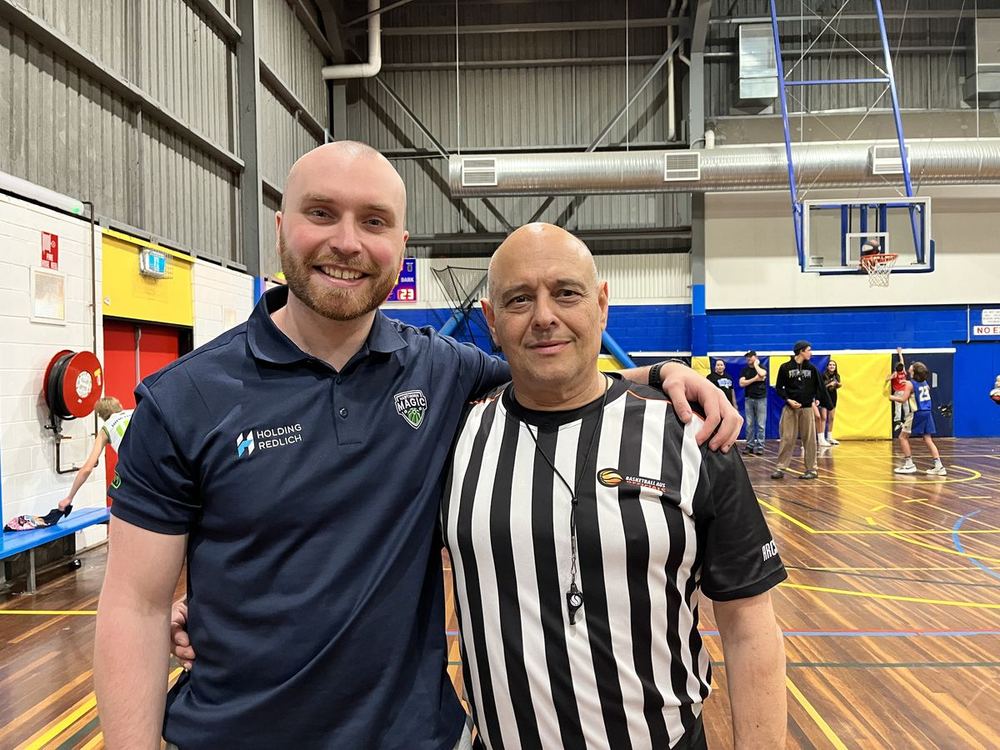
If you have a question that you want answered and it isn't here - talk to head coach Cameron and he can talk you through the question that you have.
More on costs and choosing
Next questions parents ask
Every competition in this guide
Facts on this page were compiled from the official sources below and written up in our own words. Dates, fees and venues change every season, so confirm anything you are relying on with the association directly.
This page was last updated October 2026. Spotted something wrong? Tell us.