Victorian junior basketball groups children by birth year, not school year. The cutoff is 31 December of the year the season ends, so an Under 12 player is one who does not turn 12 in that year. Because age groups usually cover two birth years, roughly half the competition is a full year younger than the other half. Ball size changes with age group too.
Last updated 24 August 2026.
This is the single most common source of confusion for a new basketball parent, because school does it the other way round. Basketball uses the calendar year of birth.
Westgate Basketball state the rule cleanly for their competition: age groups are defined by the age of a player at the 31st of December of the year the season ends. Dandenong Basketball Association say the same thing in their by laws, setting the age eligibility cutoff at midnight on 31 December of the competition year.
So Under 12 does not mean under twelve today. It means your child will not turn 12 during the relevant year. Basketball Victoria's VJBL handbook spells that out for each group: eligible Under 12 players must not turn 12 in the season's end year, Under 14 players must not turn 14, and so on.
The practical consequence is that two children in the same school class can end up in different basketball age groups, and two children two years apart can end up in the same one. Neither is a mistake.
Age groups usually span two birth years. That is deliberate, because it halves the number of separate competitions an association has to run, but it means a group always contains a bottom age cohort and a top age cohort.
A bottom age player is in the younger of the two birth years. A top age player is in the older one. At Under 12 that is a genuinely large gap. An eleven year old and a nine year old can be in the same fixture, and at that age a year of growth is a lot of centimetres.
The VJBL stretches this further at the youngest level because there is no Under 10 rep competition, so the Under 12 age group can carry more than two birth years. For 2026/27 Geelong United publish their VJBL Under 12 group as players born 2016 to 2019, against two birth years for each of Under 14, Under 16 and Under 18.
None of that is a reason to hold a child back. It is a reason to read a bad season at bottom age with some perspective, and to read a good one at top age with the same.
Do not assume the age groups you learn at one association carry across. They frequently do not, and it is the fastest way to book the wrong tryout.
Westgate publish their domestic brackets as Under 8, Under 10, Under 12, Under 14, Under 16, Under 18 boys and Under 19 girls. EDJBA runs its winter season on odd numbers instead. Its published winter age group breakdown lists Under 9, Under 11, Under 13, Under 15, Under 17 and Under 21, each mapped to named birth years season by season.
That is not an error by either of them. They are separate competitions with separate by laws, both operating under Basketball Victoria affiliation. It does mean a family moving between them has to relearn where their child sits.
The VJBL runs its own brackets again, Under 12 through Under 20. If you are looking at rep and domestic at the same time, expect three different sets of numbers describing the same child.
Ball size is the part that has genuinely changed in Victoria. In June 2021 Basketball Victoria's board endorsed a recommendation from its high performance department to mandate a size 5 basketball in all Under 12 and below competitions and training across the state, with implementation into the VJBL from the 2021/22 season. The stated reason was shooting technique: a heavy ball at a young age bakes in a shot that is very hard to fix later.
Associations then applied it to their own brackets, which is why the published tables differ. Dandenong's by laws set Under 8, Under 10 and Under 12 at size 5, Under 14 at size 6, Under 16 girls and Under 19 girls at size 6, and Under 16 boys, Under 18 boys and Under 23 men at size 7. EDJBA publishes size 5 for Under 8 to Under 11, size 6 for Under 12 to Under 14, size 7 for Under 15 and older boys and size 6 for girls. Same state, two published tables, because the age brackets themselves are different.
Ring height mostly does not change, and that is worth knowing. Basketball Victoria's own 2021 paper acknowledged that a 2.43 metre ring would be ideal for Under 12 and below, then said the range of venues and equipment across Victoria made it impractical, and that ball size was the thing it could actually control. Dandenong's by laws reflect the result: the ring is set at the standard FIBA height of 3.05 metres for Under 10 and older, and lowered to 2.6 metres only for Under 8.
Free throws get modified instead at the youngest ages. Dandenong allow Under 10 and Under 12 players to shoot from a modified line approximately one metre closer than the FIBA line, and Under 8 players to shoot one step closer. Check your own association's by laws, because these are association rules rather than statewide ones.
Most associations expect a child to play in their natural age group and treat anything else as an exception. Dandenong's by laws require players to compete in their natural age group and allow a second game in the next age group above only with club approval.
The limits are usually tight. Dandenong cap it at one age group above the natural group, no more than two junior games in a day, and require the second game to be with the player's registered team where they are playing up. A player doing that can generally only play one division below their regular age group.
Rep players are often held to the same rule in reverse. Dandenong require representative players to compete in their natural age group in the domestic competition, with exemptions only in writing and at the administrator's discretion.
If you are considering it, the question to ask your club is not whether it is allowed but whether it is good for your child. Playing up against bigger bodies is useful for a kid who is dominating and bored. It is corrosive for a kid who is already the smallest one on the floor.
By birth year. Westgate state age groups are defined by the player's age at 31 December of the year the season ends, and Dandenong set the cutoff at midnight on 31 December of the competition year. Under 12 means a child who will not turn 12 in that year.
Because age groups usually span two birth years. Roughly half the competition is bottom age and half is top age. The VJBL Under 12 group can span more than two years because there is no Under 10 rep competition beneath it.
It depends on the competition. Basketball Victoria mandated size 5 for Under 12 and below in competitions it oversees from 2021/22. Dandenong publish size 5 to Under 12, size 6 at Under 14, and size 7 for Under 16 boys and older. EDJBA, which uses different brackets, publishes size 5 to Under 11 and size 6 at Under 12 to Under 14.
Generally no. Basketball Victoria acknowledged in 2021 that a 2.43 metre ring would be ideal for Under 12 and below but was impractical across Victorian venues. Dandenong set the ring at the standard 3.05 metres for Under 10 and older, and 2.6 metres only for Under 8.
Usually only with permission and only one group above. Dandenong allow a second game in the next age group up with club approval, cap players at one age group above their natural group, and limit juniors to two games a day. Ask your own association, because the rules are local.
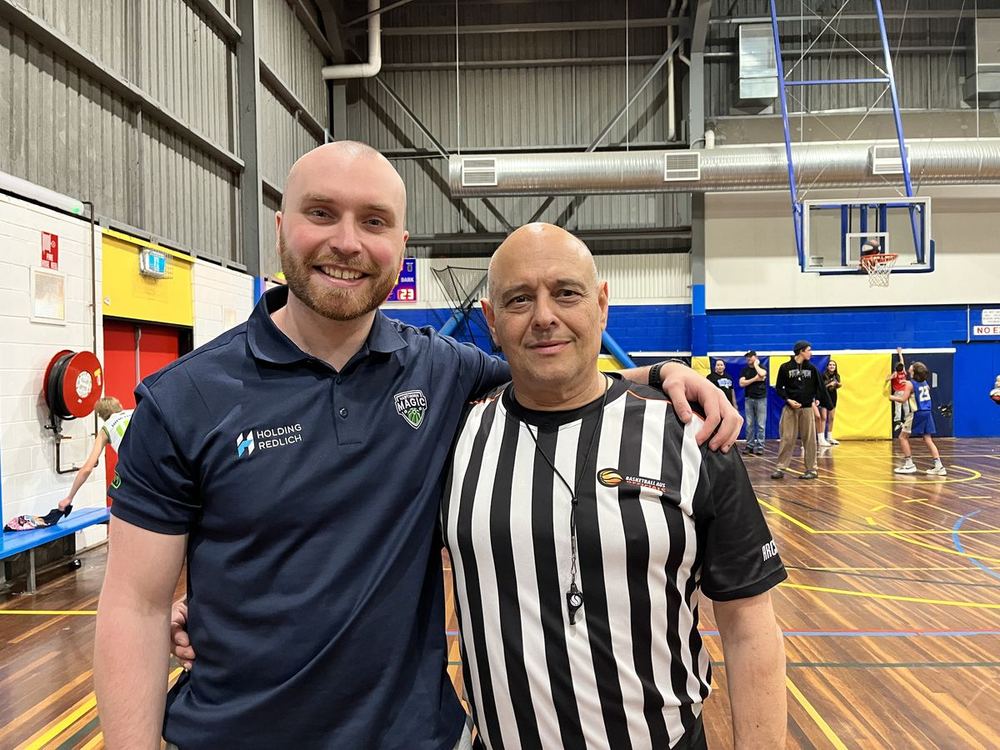
If you have a question that you want answered and it isn't here - talk to head coach Cameron and he can talk you through the question that you have.
More on costs and choosing
Next questions parents ask
Every competition in this guide
Facts on this page were compiled from the official sources below and written up in our own words. Dates, fees and venues change every season, so confirm anything you are relying on with the association directly.
This page was last updated August 2026. Spotted something wrong? Tell us.