Victoria runs several junior basketball competitions in parallel rather than one ladder. Aussie Hoops suits ages five to ten, Hoop Time is a primary schools carnival, domestic is the weekly local competition, the VJBL is representative basketball from under 12 to under 20, the Junior Country Championships serve country associations, and Big V Youth League is the senior step after juniors.
Last updated 24 August 2026.
Each competition in Victoria is owned by a different body or a different arm of the same body. Basketball Australia owns Aussie Hoops. Basketball Victoria owns Hoop Time, the VJBL, the Junior Country Championships and the Big V. Your local association owns the domestic competition. NBL1 is run nationally rather than by Basketball Victoria.
None of them has any reason to tell you that one of the others might be a better fit for your child right now. That is not a criticism, it is just how the incentives work. Every page you land on is written by the people who run that one competition.
So what follows is the comparison nobody publishes. It covers who each competition is for, what age it starts and ends, and, more usefully, what it costs a family in time. Where I have not verified a figure, I have left it out rather than estimated it.
Ford Aussie Hoops is for ages five to ten. Sessions are delivered by accredited coaches and built around warm up games, skill activities and modified games rather than competition. The time cost is low, with no travel beyond your nearest association.
Hoop Time is the primary schools carnival, split by grade rather than birth year. Grade 1 and 2 play Minis, Grade 3 and 4 play Junior, Grade 5 and 6 play Senior. Divisions separate beginners from rep players, with Mixed Rookie for genuine beginners, Future Stars for VJL6 and below, and All Stars compulsory for VJL5 and above.
The time cost of Hoop Time is a single school day, unless the team keeps winning. The program culminates each year in Regional Finals and a State Grand Final day, so a one day entry can quietly become a multi date commitment across the year.
For secondary students, the equivalent is the Victorian Secondary Schools Challenge, which runs under 15, under 17 and under 20 age groups, with regional qualifiers running through May and into early June 2026 across five venues, and finals from 16 to 18 June 2026.
Domestic is run by your local association and is where the large majority of Victorian juniors play. Teams are usually formed from a school or friendship group and graded into divisions within the association.
The time cost is the lowest of any real competition. One game a week, usually one training, almost always at the same stadium. Games are typically short and scheduled across the weekend or a weeknight depending on the association.
The trade off is that the standard within a grade can vary a lot, because teams are self forming rather than selected. A strong team and a beginner team can end up in the same division early in a season before grading settles.
The VJBL is the representative competition, covering under 12 to under 20 age groups. Basketball Victoria reports more than 1,700 representative teams from over 50 associations, with more than 17,000 participants, across more than 80 venues on Friday nights.
Basketball Victoria describes the VJBL as a graded structure running from the Victorian Junior Championship League down to regional competition. It calls the Victorian Junior Championship League the premier competition for junior teams, and associations nominate their teams into it.
The time cost is the real jump. Rep means selection through tryouts, which at Nunawading Basketball ran from 2 to 9 October 2026, a longer season, and away games at other associations rather than at your home stadium. One published example of the fee scale is Nunawading, which listed a 2026/27 representative program registration fee of $690 per athlete including GST, with the official uniform pack charged on top. Other associations set their own fees, so treat that as one data point and not a state average.
For country families there is a parallel structure. The Junior Country Championships run under 12, under 14, under 16 and under 18 age groups over multiple days in a round robin and knockout format. The 2026 under 16 and under 18 event was held at Red Energy Arena in Bendigo on 14 and 15 February. Regional affiliated associations and country Victorian athletes are accepted.
Big V Youth League is the step after the VJBL. Basketball Victoria's Big V comprises 137 semi professional sides from 49 associations across 12 competitions, with senior divisions and Youth League divisions. The 2026 Youth League levels are set by a Youth Qualification Series held on 8 February 2026, running Victorian Youth Championship, Youth League One, Youth League Two and, new on the men's side, Youth League Three.
Basketball Victoria's public Big V pages, checked 24 August 2026, do not state a Youth League age cap. Clubs describe it as under 23. Confirm with the association before planning around it.
NBL1 South sits above the Big V. It is one of five conferences in the national second tier below the NBL and WNBL, covering clubs from Victoria, Tasmania and South Australia. The 2026 season tipped off on the weekend of Friday 27 March and finished with a grand final on Saturday 15 August 2026. It is senior basketball and not a junior option.
Running alongside all of this is Basketball Victoria's high performance pathway, which is a set of selected programs and camps rather than a competition. Athletes rise into it through selection tryouts, camps and program invitations, and it feeds the Victoria Metro and Victoria Country state teams.
Ranked by what they actually take out of a family week, the order is fairly stable. Aussie Hoops is one session and no travel. Hoop Time is one school day, plus finals days if the team keeps winning. Domestic is one game plus one training at a single venue. VJBL rep adds tryouts, more training and away travel across a region or across Melbourne.
The tournaments sit outside that pattern. Junior Country Championships and similar events are concentrated multi day commitments with accommodation attached for country families, and they land on top of whatever weekly competition a child already plays.
The compounding problem is the one that catches families out. A talented fifteen year old can be simultaneously playing VJBL on Friday, training for a state program, playing school sport, and being invited into Youth League. Nobody in that chain is looking at the total, because each coach only sees their own slice.
My practical rule is to count the weekly hours before you agree to anything, then ask whether the child has two clear days a week with no basketball on them. If the answer is no, something has to come off the list, and it is usually easier to drop the thing with the longest drive.
Almost certainly domestic at your local association, with Hoop Time through school on top if the school enters. Aussie Hoops suits five to ten but most eight year olds are ready for a real weekly game.
It is if your child wants harder games and is already asking for them. It is not a requirement for enjoying the sport, and it is not the only route into Basketball Victoria's programs later on.
Many do, and it is one of the main causes of overload. Add up total weekly hours and travel across every competition before agreeing to both.
The VJBL is a weekly representative season across under 12 to under 20. The Junior Country Championships are multi day tournaments for country associations, run in under 12, under 14, under 16 and under 18 age groups.
Representative basketball, and country representative basketball most of all. Rep means away games at other associations rather than a single home stadium, and country championship weekends can add accommodation on top.
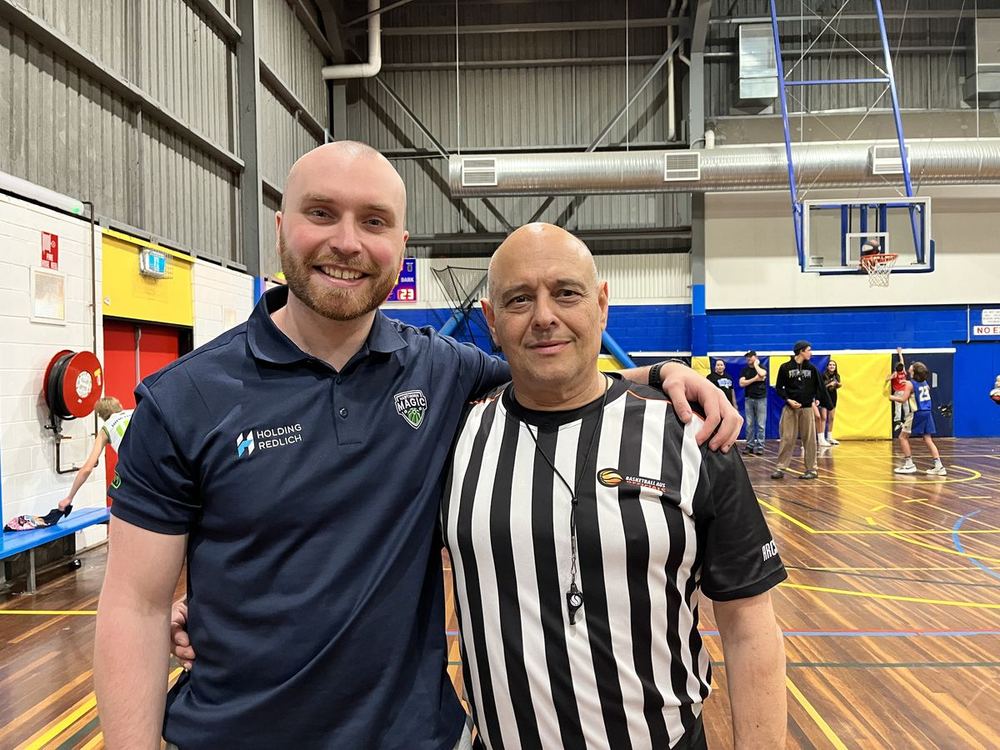
If you have a question that you want answered and it isn't here - talk to head coach Cameron and he can talk you through the question that you have.
Next questions parents ask
Every competition in this guide
Facts on this page were compiled from the official sources below and written up in our own words. Dates, fees and venues change every season, so confirm anything you are relying on with the association directly.
This page was last updated August 2026. Spotted something wrong? Tell us.