The Big V is Basketball Victoria's state league for senior and youth teams, and from the 2027 season it becomes the Victorian Basketball League, or VBL. Fixtures, results, ladders and livestreams are on Basketball Victoria's website, because bigv.com.au no longer loads. For juniors it matters in the late teens, when Youth League, an under 23 competition, becomes the next step after the VJBL.
Last updated 14 October 2026.
The Big V is the state league Basketball Victoria runs for senior and youth teams. Its own about page, using 2023 figures, describes 137 semi professional sides drawn from 49 associations, competing across 12 separate competitions covering both men and women.
The competition is older than the name. Basketball Victoria dates it to 1987, when it began as the Victorian Women's Conference. Men's and women's competitions ran independently until 2000, and the Big V name arrived in the mid 2000s after a vote of member clubs. If you hear an older parent say VBL, WVBL or CVIBL, that is the same lineage, and from 2027 the league is called the VBL.
In everyday terms, a Big V team is the senior team your local association fields. If your child plays juniors at an association, there is a reasonable chance the association also has Big V sides playing at the same stadium, and watching them is the cheapest basketball education a junior can get.
On 7 September 2026 Basketball Victoria announced that from the 2027 season, the Big V will become the Victorian Basketball League, or VBL. It says its website and competition platforms will move to the VBL name as the new season approaches.
Clubs are already using it. Casey's Youth League page calls the club the VBL Casey Cavaliers, and Basketball Hawthorn's 2026/27 handbook talks about its VBL teams for 2027.
For a while you'll see both names. Search results, club pages and parents will say Big V well into 2027, so if your child is invited to a VBL Youth League trial, it's the same competition this page describes.
Basketball Victoria describes three levels of senior competition and three levels of youth league. The senior tiers work on promotion and relegation rather than invitation, which is unusual in Australian sport and worth understanding if you follow a local club.
For 2026 the senior system moved to what Basketball Victoria calls two up and two down. The team that finishes on top of the regular season ladder earns automatic promotion, and the grand final champion also earns promotion. The two lowest placed teams on the final ladder face relegation, where previously only the last placed team went down. If only one promotion spot is available, the grand final winner gets priority.
Other 2026 changes affect squads rather than ladders. Elite stream teams keep one emergency player while development stream teams went from one to three. Twelve player team lists must be submitted before games. Basketball Victoria also named four referee points of emphasis for the season, covering verticality, protecting the dribbler in transition, pace of game and behaviour.
Youth League is where the Big V connects to junior basketball. It is the competition a player typically moves into after finishing in the VJBL, and clubs describe it as the natural landing spot for graduating juniors.
The 2026 Youth League structure is set by a Youth Qualification Series held on 8 February 2026 across Narrandjeri Stadium and Dandenong Stadium. Teams qualify into a level rather than being placed there. Basketball Victoria says teams reach the series by finishing in the top four or bottom four of their competition after finals, and that places are earned or defended rather than handed out. Basketball Victoria lists the levels as Victorian Youth Championship, Youth League One, Youth League Two and Youth League Three, and 2026 was the first year Youth League Three Men was part of the qualification series.
Basketball Victoria's wrap of the 2026 season counts more than 1,500 games across 13 divisions. On the youth side that means the Victorian Youth Championship, Youth League One and Youth League Two for both men and women, plus Youth League Three for men only.
Basketball Victoria's 2026 Big V rules settle it. Youth League is for players who are 23 or younger in the year of the competition, so for 2027 a player must be born in 2004 or later. Across every division, a player must turn at least 14 during the year they register.
Youth League squads are picked by clubs, not by Basketball Victoria. Nunawading, for example, ran its trials in October for the following season, and Casey's page for 2027 says players must be 23 and under in 2027, and that dates, times and locations are emailed only to invited athletes. Nunawading's were on 19, 21 and 23 October last year, with registrations closing two days before the first session.
So if your child is in their last VJBL years and wants to keep going, ask your association in September whether it runs a Youth League trial and how to get an invite.
If you have an old bookmark for bigv.com.au, it no longer works. We checked again on 14 October 2026 and the domain still doesn't respond, on either the bare domain or the www version. It times out rather than redirecting, which is why old search results still point at it.
Everything now sits on Basketball Victoria's own website, under basketballvictoria.com.au/bigv: fixtures, results, ladders, statistics and videos. The videos page is where live and recorded games are shown, and the 2026 rules require every Championship team to livestream its home games to the destination the league sets.
Bookmark the Basketball Victoria pages directly rather than searching for Big V each time. With the VBL name arriving for 2027, the addresses may change again, and Basketball Victoria says its competition platforms will move over as the season approaches.
The 2026 season opened with the Youth rounds on 14 and 15 March, the senior divisions on 21 and 22 March and the Championship on 28 and 29 March. The Youth grand finals were on 8 and 9 August, the senior grand finals on 22 and 23 August, and the Championship grand finals on Saturday 29 August, where McKinnon won both Championship titles.
Basketball Victoria hadn't published 2027 season dates when we checked on 14 October 2026. The only hint so far is on the 2026/27 VJBL Under 20 calendar, which marks Sunday 14 March 2027 as the week the Big V begins and notes a Youth Qualification Sunday in early February. Treat both as a guide until the VBL publishes its own dates.
Big V is senior basketball. Training loads, travel and expectations are set for adults and near adults, not for a child being introduced to the sport. A sixteen year old training with a Youth League squad is training alongside players in their early twenties.
That is often exactly what a strong junior needs, and it is also how a lot of players get burnt out. Playing VJBL on a Friday night and Youth League on a weekend is a genuinely heavy load for a school student, on top of school sport and whatever else they do.
If your child is being invited to both, the conversation to have with both coaches is about total weekly volume, not about which team is more important. Coaches will usually work with you on it if you ask early, and they will not know there is a clash unless somebody tells them.
No. The VJBL is the junior representative competition for under 12 to under 20 age groups. The Big V is Basketball Victoria's senior state league, with separate senior and Youth League divisions.
Checked again on 14 October 2026, the domain still doesn't respond on either the bare or www version. Big V fixtures, results, ladders and videos now live on Basketball Victoria's site under basketballvictoria.com.au/bigv.
For 2026 Basketball Victoria uses a two up, two down system. The regular season ladder leader and the grand final champion earn promotion, and the two lowest placed teams face relegation.
23 or younger in the year of the competition, under Basketball Victoria's 2026 Big V rules. For 2027 that means born in 2004 or later. Every player must also turn at least 14 during the year they register.
Only if the total weekly load works. Youth League is senior basketball, and combining it with VJBL and school sport is a heavy schedule for a school student.
From the 2027 season, yes. Basketball Victoria announced on 7 September 2026 that the Big V will become the Victorian Basketball League, or VBL.
On Basketball Victoria's website, at basketballvictoria.com.au/bigv/fixtures. The old bigv.com.au address no longer loads.
On the videos page of Basketball Victoria's Big V section, which shows live and recorded games. Championship teams are required to livestream their home games.
Basketball Victoria hadn't published 2027 dates by 14 October 2026. The 2026/27 VJBL Under 20 calendar marks Sunday 14 March 2027 as the week the Big V begins, so treat that as a guide.
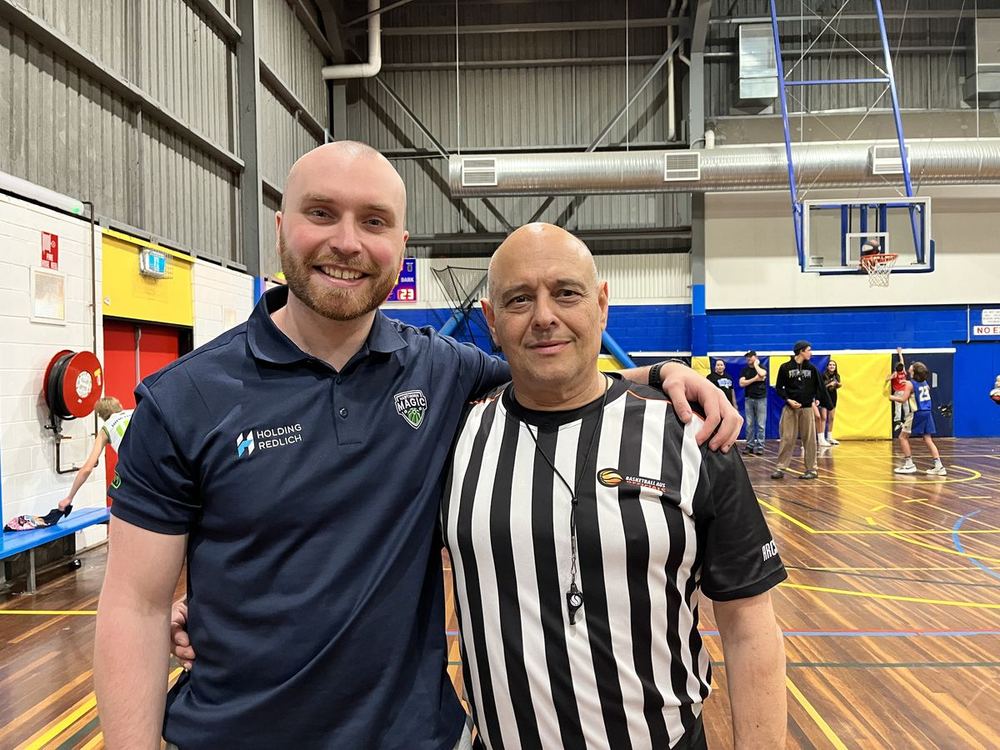
If you have a question that you want answered and it isn't here - talk to head coach Cameron and he can talk you through the question that you have.
Next questions parents ask
Every competition in this guide
Facts on this page were compiled from the official sources below and written up in our own words. Dates, fees and venues change every season, so confirm anything you are relying on with the association directly.
This page was last updated October 2026. Spotted something wrong? Tell us.