FIBA's new Official Basketball Rules took effect worldwide on 1 October 2026. The unsportsmanlike foul is gone, replaced by a less serious disruptive foul and a more serious flagrant foul, and technical fouls now come in two categories. Junior competitions are not all switching on that date. At least one Victorian association has said it will wait until 2027, so check your own association's notice.
Last updated 9 October 2026.
FIBA, the International Basketball Federation, writes the Official Basketball Rules. Junior competitions in Victoria and NSW play under those rules, with their own local changes added on top. On 22 September 2026 FIBA announced that a new edition would take effect worldwide on 1 October 2026. The rulebook says the FIBA Central Board approved it in Berlin on 23 April 2026, and FIBA first published its summary of the changes on 26 June 2026.
FIBA explains the biggest change plainly. Under the previous rules, two technical fouls, two unsportsmanlike fouls, or one of each meant a player was disqualified from the game, and FIBA's rule changes document says that appears overly strict. The new rules sort fouls by how serious they are, so that only the more serious ones count towards a player being sent off.
The NBL has said it will bring in the new rules during its 2026/27 season, starting at the NBL Blitz. That is the professional league. Junior competitions make their own decisions, which are covered further down. The main changes are listed here and explained one by one in the sections below.
The unsportsmanlike foul is no longer in FIBA's rules. FIBA has replaced it with two fouls, separated by how serious the contact is.
A disruptive foul is the less serious of the two. FIBA defines it as illegal contact that is not bad enough to be flagrant but that interrupts the flow of the game and leaves the opponent at a disadvantage. There are three situations. First, a defender makes unnecessary contact, without a genuine attempt to play the ball, to stop the attacking team on a fast break (FIBA's word is transition). Second, a defender anywhere on the court does the same to stop the game clock or shot clock at the end of a quarter or overtime. Third, a player makes illegal contact from behind or from the side on an opponent heading to the basket with no defender in between, when that opponent has the ball, is trying to get it, or has a pass already on the way. The fast break and from behind situations stop applying once the attacking player starts the act of shooting.
A flagrant foul is the more serious one. FIBA describes it as illegal contact that goes against the spirit of sportsmanship and fair play and goes beyond a normal or disruptive foul. Its three tests are contact that is not a legitimate basketball play, a reckless, violent or dangerous act that causes or could cause injury, and excessive, hard contact even when the player is trying to play the ball.
The free throws and possession work the same way for both. The fouled player gets two free throws if they were not shooting. If they were shooting, a made basket counts plus one free throw, and a miss means two or three free throws. Their team then takes the ball out from the throw in line in its attacking half, opposite the scorer's table. Both fouls are charged to the player and count as team fouls. The big difference is what happens next: a flagrant foul counts towards being sent off, and a disruptive foul does not.
Illustration only, not a ruling: in an under 14 game, a player races away on a fast break and a defender grabs her arm, making no attempt to reach the ball. FIBA's official interpretations give almost exactly this example and call it a disruptive foul. If the defender had genuinely reached for the ball and caught the arm, FIBA says being on a fast break is not enough on its own to make that disruptive. If a defender instead pulls hard on a player's shoulders while she is in the air for a lay up, FIBA's interpretations give that as an example of a flagrant foul. On the day, the referee decides.
A technical foul is mostly about behaviour or administrative rules, rather than the ordinary contact of play. From 1 October 2026 FIBA puts technical fouls into two categories.
Category 1 is the more serious kind and counts towards being sent off. FIBA's examples include disrespect towards referees, table officials, opponents or people sitting on either bench, language or gestures that could offend or stir up spectators, taunting or provoking an opponent, waving a hand near an opponent's eyes, swinging elbows excessively without making contact, and faking a foul.
Category 2 is the less serious kind and does not count towards being sent off. FIBA's examples are deliberately delaying the game, such as touching the ball after it goes through the net, stopping a throw in or free throw from being taken promptly, or being late onto the court at the start of the game or the second half. Two more category 2 examples are a defender goaltending the last free throw, and hanging on the ring with the ring taking the player's weight, unless it is a brief grab after a dunk or to avoid injuring someone.
Under the 2026 rules a player is sent off, which FIBA calls game disqualification, for two category 1 technical fouls, two flagrant fouls, or one of each. Disruptive fouls and category 2 technical fouls never count towards that. Every technical foul on a player, whichever category, is charged as one of that player's fouls and counts as a team foul, and FIBA's 2026 rulebook says a player who reaches five fouls must leave the game.
Illustration only, not a ruling: a 15 year old hangs on the ring after a lay up, and later grabs an opponent to stop a fast break without trying for the ball. Under FIBA's categories the first fits a category 2 technical foul and the second a disruptive foul, so neither counts towards being sent off, but both count towards the five foul limit. Some associations add their own consequences for hanging on the ring, so check your local by-laws. Two category 1 technical fouls, for example for disrespect towards a referee, would see a player sent off.
Whether a player was shooting matters. A foul on a shooter brings free throws, while a foul on a player who was not shooting usually means a throw in, unless the fouling team has already committed four team fouls in that quarter. FIBA says it tightened the definition because more and more players were manipulating situations to earn shooting fouls.
On jump shots and other shots on the move, the act of shooting now starts when the player begins moving the shoulders and the ball upwards towards the basket. On drives to the basket, it starts once the player has gathered the ball and it is at rest in their hands, after a dribble or a catch, and the player carries on into the shooting motion. FIBA says these drives typically start between the three point line and the basket.
A player must be in the frontcourt, the half their team is attacking, to be in the act of shooting. The exception is the last action before the game clock runs out at the end of a quarter or overtime, or before the shot clock runs out.
FIBA also added two new ways for a player to stop counting as a shooter on a jump shot. If, after being fouled, the player moves the ball upwards in a direction away from the basket, or brings it up while not facing the basket, they are no longer treated as shooting. As before, passing the ball off after the foul also means the player is no longer treated as shooting, on a jump shot or a drive.
Illustration only, not a ruling: an under 16 guard dribbles in her own backcourt with plenty of time on the shot clock, gathers the ball, throws it towards the ring and is fouled on the gather. FIBA's interpretations use a very similar example and say the player was not in the act of shooting, because she was still in the backcourt. It would be different if that throw was the last action before the quarter or the shot clock ran out.
FIBA's Instant Replay System only comes into play in games where approved video equipment is used, and it now covers two more situations. At any time in the game, referees can review whether goaltending or basket interference happened after a foul and whether it was called correctly. Goaltending is touching a shot while the ball is completely above the ring and either on its way down to the basket or after it has hit the backboard. In the last two minutes of the fourth quarter and in overtime, referees can also review whether the ball was still in the thrower's hands, or at their disposal, when the defence fouled during a throw in. Collingwood Basketball Association's post makes the same point about approved video technology.
Socks no longer have to be visible. FIBA says that reflects modern equipment and reduces unnecessary interruptions and enforcement problems. The rulebook says all team members' socks must be the same dominant colour. FIBA also allows more freedom with line colours, as long as all the boundary lines are one colour and each pair of court markings matches in both halves.
There are new referee signals for a disruptive foul, a flagrant foul and delay of game, and new scoresheet markings. Under the new marking system any foul that counts towards being sent off is circled, which is worth knowing if you take a turn on the scoring bench. FIBA also reworded the double dribble rule and says the new wording removes possible inconsistencies in how it is interpreted.
This is the question most parents are really asking, and the honest answer is that it depends on your competition. FIBA's date is 1 October 2026, but PlayHQ, which provides the basketball eScoring app, says not every competition switches over on the same day. Here is what each body had published when we checked on 9 October 2026.
Basketball Victoria: we could not find a published implementation date from Basketball Victoria on 9 October 2026. Its news page and its Rules of the Game page had no notice about the 2026 changes when we checked.
VJBL: Basketball Victoria's VJBL Association Contact Handbook for the 2026/27 season says VJBL games start on 20 November 2026 and run to 17 September 2027. Neither the handbook nor the VJBL Rules of Operation on Basketball Victoria's VJBL resources page says whether the new foul rules apply from the first game. The Rules of Operation say FIBA rules apply with some amendments. Separately, the VJBL has its own suspension system for technical fouls. Its Tech Foul Rule, dated 5 August 2026, sorts them into non abusive and abusive, which decides how long a technical stays on a person's record: a six game good behaviour period for non abusive, and 12 months for abusive. Those are VJBL labels, not FIBA's category 1 and category 2, and the document does not link the two.
Southern Basketball Association, based in Cheltenham: when we checked on 9 October 2026, its FIBA 2026 Rule Change page said it will not adopt the 2026 changes until its 2027 Autumn domestic season begins, and that it will share more information with its community before then.
Chelsea & District Basketball Association: on 2 October 2026 it posted a parent guide saying the new rules kicked in on 1 October 2026, and that its sin bin still applies. The guide also lists changes it says will not affect domestic games, such as court line colours, uniforms, scoresheet markings and video replay. That list is Chelsea's guidance for its own competition. We could not find a matching statement published by Basketball Victoria.
Collingwood Basketball Association: on 8 October 2026 it encouraged its basketball community to understand the changes ahead of the upcoming season, and said the new foul types, technical fouls and shooting foul changes are the most important to understand for its domestic and representative programs. It did not give a date for its own competitions.
EDJBA: its Summer 2026/27 season starts on Saturday 10 October 2026. Its by-laws, approved on 31 August 2026 and applying from that season, say its games use Basketball Victoria's rules with listed exceptions. They do not mention the new fouls, and we could not find a published EDJBA statement on when its games switch.
Basketball NSW: we could not find a published implementation date from Basketball NSW on 9 October 2026, in its news or in its 2027 Waratah Junior League Rules of Operation. That document, dated as at 21 September 2026 and hosted on the Basketball NSW website, says the junior leagues are played under FIBA's rules unless the Rules of Operation say otherwise. It does not mention disruptive or flagrant fouls and does not say when the 2026 edition starts to apply.
Hills Basketball Association (Hills Hornets): its Competition By-Laws, revised August 2026 and marked effective for Summer 2026/2027, already use the new foul names. Under those by-laws, two category 1 technical fouls, two flagrant fouls, one of each, or a disqualifying foul means a player is ejected, while category 2 technical fouls and disruptive fouls do not count towards that. Hills also has its own extra rule: a player given a category 1 technical foul or a flagrant foul must sit out at least five minutes of playing time, except in fully timed Premier League games. That sit out rule is a Hills by-law, not a FIBA rule.
Inner West Bulls: when we checked on 9 October 2026, its Domestic Competition By-laws page still referred to the old unsportsmanlike foul, for example in its rules on ejections and five minute suspensions. If your association's documents still use the old names, ask which version its referees are applying.
Other associations: if yours is not mentioned here, check its website, emails and social media pages for a notice, or ask your club.
Basketball Australia: we could not find a published implementation notice in Basketball Australia's news on 9 October 2026 either.
Scoring software is a useful clue. When we checked on 9 October 2026, PlayHQ's help article on basketball eScoring said the new foul types became available in eScoring from 1 October 2026. It also said that in Australia, competition administrators switch the new rules on grade by grade, and that each grade begins with them switched off. So if a scorer opens a game and the foul list still shows Technical and Unsportsmanlike, that grade has not been changed over yet. PlayHQ says fouls already recorded are kept exactly as they were scored.
So the simple steps are these. Read your association's news page and emails for a rule change notice. Ask your coach or team manager whether your grade is using the 2026 rules. If you are scoring, look at the foul buttons before the game starts. And if a call on the day sounds unfamiliar, be patient with referees and scorers while competitions change over.
Five fouls still ends a player's game. FIBA's 2026 rulebook says a player who has committed five fouls must leave the game, and the five foul limit is not among the changes in FIBA's summary. PlayHQ's guide says disruptive fouls and category 2 technical fouls count towards the five, but never towards the two fouls that send a player off on their own.
Your association's own junior rules still sit on top of FIBA's. EDJBA's by-laws, in the version approved on 31 August 2026, ban zone defence from under 8 to under 14, change the three second rule to five seconds for under 12 and younger, and bring the free throw line 1.8 metres closer for under 8 and under 9. Basketball NSW's 2027 Waratah Junior League rules, dated as at 21 September 2026, require every under 12 player to take the court in each half, use a closer free throw line in under 12, count every under 12 field goal as two points, ban zone defence in under 12 and under 14, and include a mercy rule for big margins.
Chelsea & District's guide says its sin bin still applies, and Hills has its own five minute sit out rule. None of the changes in FIBA's summary deal with zone defence, mercy rules or junior game lengths, so those stay whatever your competition's own rules say.
FIBA's documents can be downloaded from its website and are the final word on wording. FIBA says its summary of changes does not include every minor or editorial change, and that where the summary and the full rulebook differ, the rulebook wins. For when your child's games switch over, your own association is the final word.
Not necessarily. FIBA's rules took effect on 1 October 2026, but competitions are not all switching on the same day. Southern Basketball Association in Victoria says it will wait until its 2027 Autumn domestic season, and PlayHQ says Australian grades are switched on one at a time. Check your association's notice.
It is the less serious of the two fouls that replaced the unsportsmanlike foul. It covers unnecessary contact, without a genuine attempt to play the ball, to stop a fast break or to stop the clock at the end of a quarter, and illegal contact from behind or the side on a player with a clear run to the basket. It gives free throws and the ball, but does not count towards being sent off.
Under the 2026 FIBA rules, only if both are category 1 technical fouls, the more serious behaviour kind. A player is sent off for two category 1 technical fouls, two flagrant fouls, or one of each. Category 2 technical fouls, such as delaying the game, do not count towards that. Local by-laws can add their own suspensions, so check yours.
Yes, towards the usual five fouls. FIBA charges a disruptive foul to the player who commits it, and PlayHQ's scoring guide says disruptive and category 2 technical fouls count towards a player's five fouls, but never towards the two that end a game on their own.
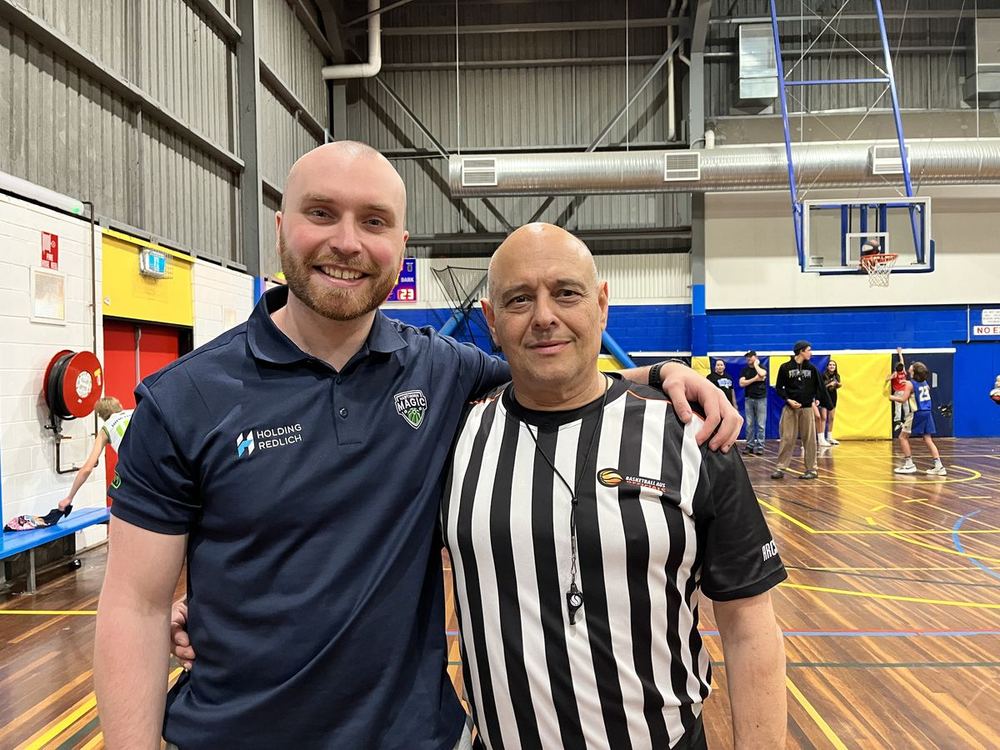
If you have a question that you want answered and it isn't here - talk to head coach Cameron and he can talk you through the question that you have.
More on reference
Next questions parents ask
Every competition in this guide
Facts on this page were compiled from the official sources below and written up in our own words. Dates, fees and venues change every season, so confirm anything you are relying on with the association directly.
This page was last updated October 2026. Spotted something wrong? Tell us.