NBL1 South is one of five conferences in NBL1, Australia's second tier below the NBL and WNBL. It covers clubs from Victoria, Tasmania and South Australia, running men's and women's competitions. It launched in 2019 in place of the Victorian arm of SEABL, and sits a level above Basketball Victoria's Big V.
Last updated 24 August 2026.
NBL1 is a national semi professional competition structured into five conferences, named North, East, South, West and Central. It sits at the second level of Australian basketball, below the professional NBL and WNBL, and runs men's and women's competitions in every conference.
It did not appear all at once. NBL1 launched in 2019 with a single conference, the South, formed from the Victorian clubs of the old South East Australian Basketball League. The North and Central conferences followed in 2020, the West in 2021 and the East in 2022, each formed by absorbing an existing state league.
For a Victorian family, the useful summary is that NBL1 South is the highest level of basketball your local association is likely to field a team in. Above it, you are talking about the NBL and the WNBL, which are professional national leagues with a small number of clubs.
NBL1 South is not Victoria only. The conference draws clubs from Victoria, Tasmania and South Australia. Mount Gambier's Pioneers play in the South, as do the Hobart Chargers, and a new Tasmanian club called Northern Force joined for 2026 representing the north and north west of that state.
The Victorian clubs will be familiar names if your child plays juniors, because many are the same associations that run VJBL programs. That overlap is the point. A Victorian association can run a domestic competition, a VJBL program, a Big V side and an NBL1 South team out of the same stadium.
If you want to know whether your association has an NBL1 South team, the fastest check is the club list on the NBL1 site rather than the association's own page, because association sites often bury senior programs under a separate menu.
Names change more often than you would expect at this level. Clubs merge, rebrand and relocate between seasons, and a team your child hears about from an older sibling may not carry the same name now. Check the current season list rather than relying on what a stadium sign says.
The two are easy to confuse because both are senior competitions with Victorian clubs, and some associations field teams in both. The difference is level and reach. NBL1 South is a conference of a national competition sitting at the second tier of Australian basketball. The Big V is Basketball Victoria's own state league.
NBL1 also has something the Big V does not, which is a national end point. Conference champions meet in NBL1 National Finals, so an NBL1 South club is playing towards a national title rather than a state one.
The Big V, in exchange, has promotion and relegation between its own tiers and its own Youth League structure for players coming out of the VJBL. Neither one is a stepping stone to the other in any formal sense. They are separate competitions that happen to draw from overlapping pools of players and clubs.
The 2026 NBL1 South season tipped off on the weekend of Friday 27 March, with the grand final held on Saturday 15 August 2026. Pre season began in mid February, with an NBL1 South Blitz event over 13 to 15 March.
The biggest structural change for 2026 was the finals series, which expanded from eight teams to ten. The top four teams now receive a bye in the first week of finals, replacing the double chance format that ran previously.
The season also carries themed rounds, including an ANZAC Day fixture, a heritage round and a First Nations Round observed across all NBL1 conferences. For a family, that matters mainly because themed rounds tend to be the best value nights to take a junior along to.
Practically, almost nothing in the short term. NBL1 South is senior basketball, and no junior pathway decision at twelve or fourteen should be made with reference to it. It is a destination, not a filter.
Where it does matter is as something to watch. NBL1 South games are played at the same suburban and regional stadiums your child trains in, tickets are cheap compared with an NBL game, and the standard is high enough that a junior can see how a real half court offence works.
It also matters as a realistic ceiling worth naming out loud. A player who ends up in an NBL1 South squad has reached a genuinely high level of Australian basketball. Framing that as the goal, rather than the NBA, keeps expectations somewhere a family can actually live with.
There is one more reason to pay attention. NBL1 South squads are full of people who coach juniors during the week. The person running your child's rep training may well be playing at this level, and knowing that gives a young player a very different attitude at Tuesday night training.
No. The NBL is the professional top tier. NBL1 is the semi professional level below it, split into five conferences across the country, with NBL1 South covering Victoria, Tasmania and South Australia.
Victoria, Tasmania and South Australia. Mount Gambier, Hobart and a new club called Northern Force representing northern Tasmania all play in the South conference in 2026.
The 2026 season tipped off on the weekend of Friday 27 March, with the grand final on Saturday 15 August 2026. Pre season activity started in mid February.
Yes. NBL1 sits at the second tier of Australian basketball nationally, while the Big V is Basketball Victoria's state league. They are separate competitions rather than formal steps in one ladder.
It is senior basketball, so it is not a junior competition. It is best understood as a destination years down the track, and in the meantime as an affordable, high standard game to watch locally.
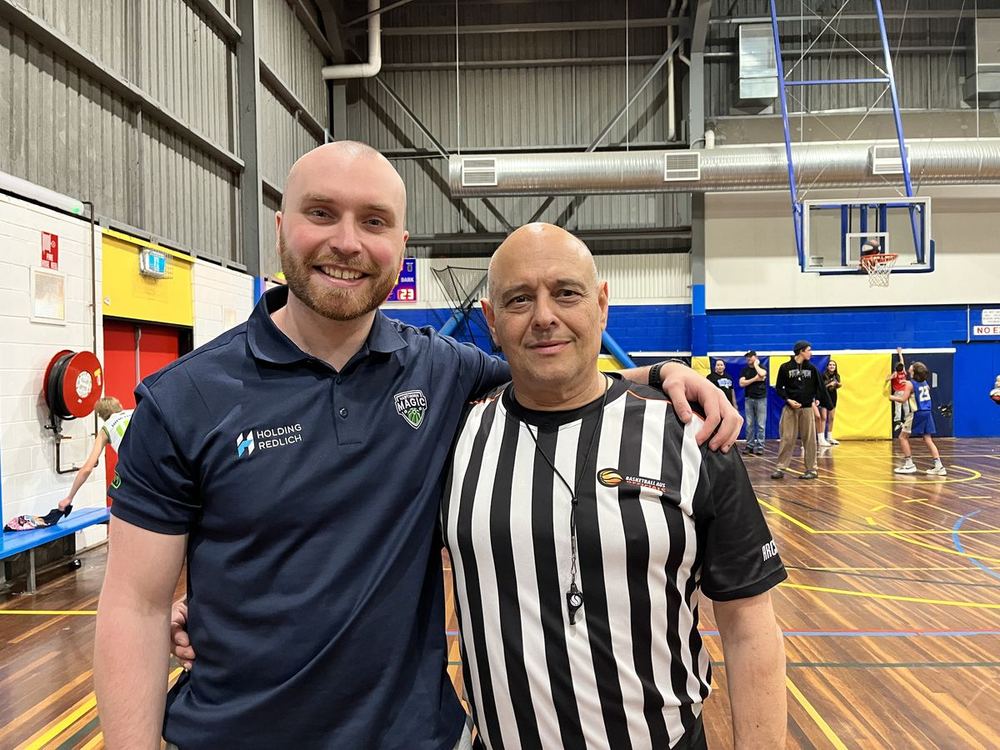
If you have a question that you want answered and it isn't here - talk to head coach Cameron and he can talk you through the question that you have.
Next questions parents ask
Every competition in this guide
Facts on this page were compiled from the official sources below and written up in our own words. Dates, fees and venues change every season, so confirm anything you are relying on with the association directly.
This page was last updated August 2026. Spotted something wrong? Tell us.