Victorian junior basketball runs in rough order from Aussie Hoops at five to ten, into domestic club competition, then rep basketball in the VJBL, then Basketball Victoria's development squads and the Vic Metro or Vic Country state teams, then Big V Youth League or NBL1 South, and for a very small number the NBL, the WNBL or US college. Almost nobody travels the whole thing.
Last updated 24 August 2026.
The first rung is Ford Aussie Hoops, which Basketball Australia runs as its official introductory program. Basketball Victoria lists it for children aged five to ten, delivered by accredited coaches who are periodically assessed. Sessions are built around warm up games, skill activities and modified games rather than a scoreboard.
Basketball Victoria describes it as a structured, federally endorsed program a child can take part in over a five year period, which is a polite way of saying there is no rush to move on.
Plenty of families skip Aussie Hoops entirely and start in a local domestic competition at eight or nine. That is fine. Aussie Hoops exists because a five year old cannot usefully play a real game yet, not because it is a gate you have to pass through.
Domestic is the weekly local competition your association runs. Teams are usually formed from a school, a friendship group or a club within the association, and they play a graded competition against other teams in the same association. One game a week, usually one training, usually the same stadium every time.
This is the level almost every Victorian kid plays at, and for most of them it is the whole story. That is not a failure of ambition. It is a well run weekly game that keeps a child fit, social and improving, at a fraction of the cost and travel of anything above it.
The important thing to understand is that domestic is not a waiting room for rep. A child can play domestic from under eights all the way through their teens and never try out for anything, and still get everything worth getting out of the sport.
Representative basketball in Victoria mostly means the Victorian Junior Basketball League. Basketball Victoria puts the VJBL at more than 1,700 representative teams from over 50 associations, with more than 17,000 participants, across age groups from under 12 to under 20, playing in more than 80 venues on Friday nights.
Basketball Victoria describes the VJBL as a graded structure running from the Victorian Junior Championship League down to regional competition. It calls the Victorian Junior Championship League the premier competition for junior teams, and associations nominate their teams into it.
Rep is where the cost and the travel jump. Your association selects teams through tryouts. Making a team is not a verdict on your child. Squads are capped, birth years cluster unevenly, and a coach picking ten from forty is making judgement calls.
Above association rep sits Basketball Victoria's high performance pathway, which it runs as a series of programs and camps for elite athletes across metropolitan and country Victoria. Athletes rise into it through selection tryouts, camps and program invitations rather than by applying.
Whether your child is on the metropolitan or the country side of that pathway is decided by postcode, not by preference. Basketball Victoria uses postcode to determine eligibility for Victoria Country or Victoria Metropolitan representation. That is worth knowing before you assume a move across town changes anything.
The two sides meet at the Country Metro Challenge. In 2026 that ran on Saturday 27 and Monday 29 June at Red Energy Stadium in Bendigo, with 194 athletes selected, 72 from country associations and 122 from metro, drawn from more than 50 associations. The end point is a Victorian state team. For 2026, Basketball Victoria named Victoria Metro and Victoria Country teams in both the men's and women's under 18 age groups for the Foot Locker Under 18 National Championships at Moreton Bay in Queensland from 12 to 19 April 2026.
Once a player ages out of juniors, the two senior options most Victorians hear about are the Big V and NBL1 South. The Big V is Basketball Victoria's own state league. Its own page describes 137 semi professional sides from 49 associations across 12 competitions, with senior divisions and Youth League divisions running alongside each other.
NBL1 sits a level above. It is a national second tier structured into five conferences, and NBL1 South covers Victoria, Tasmania and South Australia. It launched in 2019, replacing the Victorian arm of the old SEABL competition. Above that again are the NBL and the WNBL, which are the professional leagues.
There is also a direct route that bypasses all of it. The NBL's Next Stars program signs NBA draft eligible players, pairs each one with the NBL club that best suits them and gives them a professional season in front of American coaches and scouts. The youngest ever signed was sixteen. It is real, it works, and the number of Australian juniors it takes each year is tiny.
Basketball Australia has run its Centre of Excellence since 1981 at the Australian Institute of Sport in Canberra. Basketball Australia describes it as a holistic development program combining world class coaching, sports science and recovery with academic and interpersonal learning, and it names Andrew Bogut, Patty Mills and Lauren Jackson among the players who came through it. Selection comes through the national pathway, not through a form you fill in.
Basketball Australia also lists US college recruitment as a distinct pathway alongside the Centre of Excellence. American college basketball takes a meaningful number of Australian juniors each year, and the recruiting process runs on different timelines, different eligibility rules and a different academic standard to anything in the Victorian system.
If college is genuinely on the table for your family, the two things that decide it early are school results and verified game footage. Neither of those is something a Victorian association handles for you. Start those conversations well before the final year of school, not during it.
Look at the numbers honestly. More than 17,000 juniors play VJBL in a season. Basketball Victoria named 194 athletes for one Country Metro Challenge. Basketball Victoria named twelve athletes in each of the 2026 Victorian under 18 state teams. The NBL has ten clubs. The funnel does not narrow gently, it narrows brutally, and it does so on birth date, growth timing and luck as much as on ability.
That is not an argument against trying. It is an argument against treating the pathway as a ladder your child is failing to climb fast enough. Most of the value in junior basketball is banked at the bottom of the diagram, in the weekly game, the teammates and the habit of showing up.
The practical version for parents is this. Pick the level where your child gets real minutes and enjoys the drive home. If they outgrow it, the next level is there next season. Nobody has ever been permanently locked out of Victorian basketball by spending an extra year in a competition they were happy in.
Realistically, under 12s and up, because that is where the VJBL age groups begin. Before that, the useful measure is whether your child wants to go to training, not which program they are in.
Association rep is the normal route into Basketball Victoria's development squads, because that is where selectors watch. But plenty of players join rep late after growing or improving, and tryouts come around every year.
They are two separate Victorian representative streams that both send teams to national championships. Basketball Victoria decides which one your child is eligible for using your postcode, not your preference.
NBL1 sits above the Big V. NBL1 is a national second tier under the NBL and WNBL, while the Big V is Basketball Victoria's state league with its own senior and Youth League divisions.
They keep playing domestic, which is where the overwhelming majority of Victorian juniors play. They can try out again the following year, and many players who make rep at 15 or 16 did not make it at 12.
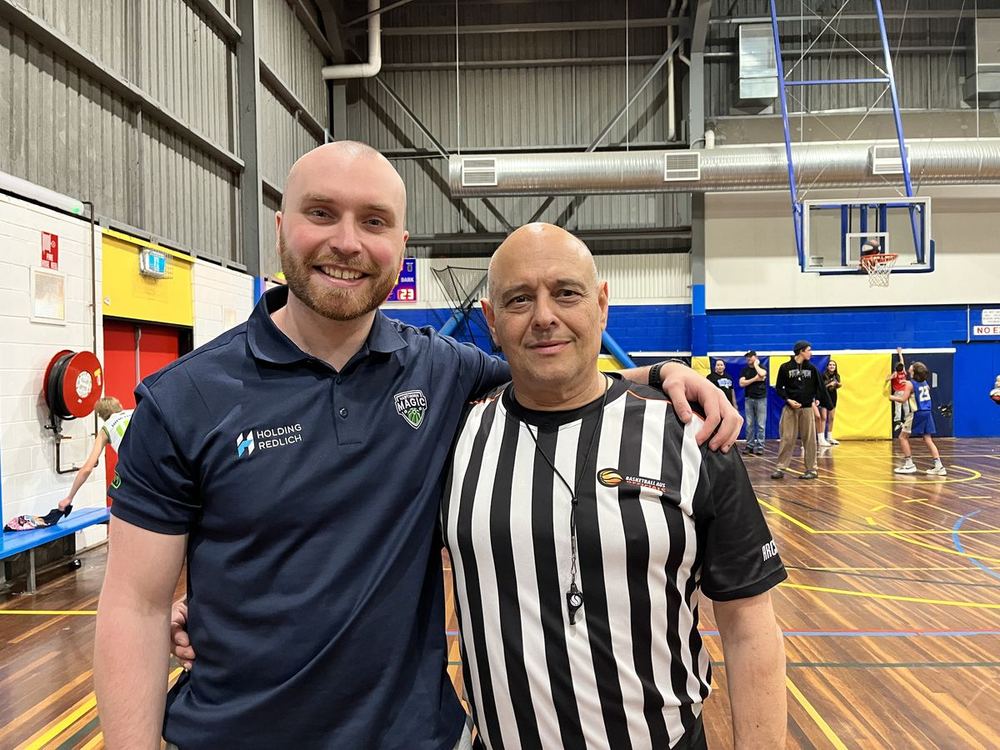
If you have a question that you want answered and it isn't here - talk to head coach Cameron and he can talk you through the question that you have.
More on start here
Next questions parents ask
Every competition in this guide
Facts on this page were compiled from the official sources below and written up in our own words. Dates, fees and venues change every season, so confirm anything you are relying on with the association directly.
This page was last updated August 2026. Spotted something wrong? Tell us.